
Use our borrowing power calculator to get an estimate of how much you may be able to borrow. This figure helps you understand your budget. It also shows what price range you can confidently target.
Your borrowing power is one of the most important numbers in the home loan process because it directly influences which properties you can consider.
Keep in mind that borrowing capacity can vary significantly between lenders. Two different banks may approve amounts that differ by thousands of dollars.
This can impact whether you secure your ideal property or need to adjust your expectations.
We work with you to compare lenders and structure your application to suit your financial situation, helping you move one step closer to your property goals.
How to use it: click Launch Calculator below, enter your details to see your estimate, then change the figures to compare different scenarios.

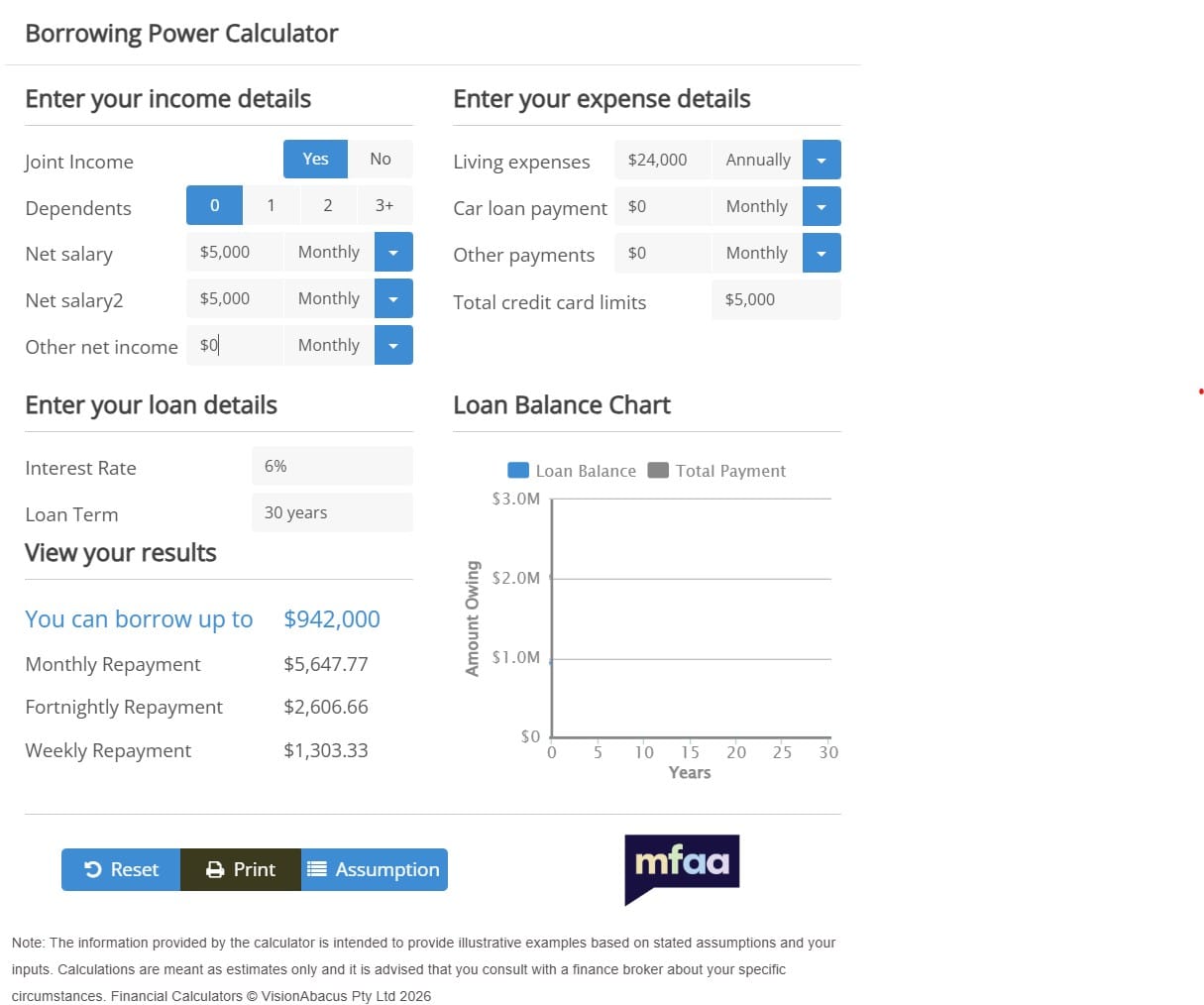
Borrowing Power Calculator
Estimate how much you may be able to borrow based on your income, expenses and existing commitments.
How to Use the Borrowing Power Calculator
The borrowing power calculator above gives you a quick estimate of how much a lender may be willing to lend, based on the figures you enter. It works best when you use real numbers from your payslips and bank statements rather than rough guesses.
- Enter each applicant’s income before tax, including regular extra income such as overtime or rental income.
- Add your living expenses. Be realistic here, because lenders check your bank statements.
- List your existing debts, including car loans, personal loans, HECS or HELP debt and the full limit of every credit card.
- Then change one figure at a time to see which inputs move the result the most.
How to Read Your Result
Treat the result as a starting point, not an approval. The figure shows roughly what your income could support after your expenses and debts are taken into account. However, each lender runs its own serviceability model, so the same inputs can produce quite different answers at different banks. Our article on why different banks give different borrowing capacities explains why.
Also remember that borrowing power is not the same as your purchase price. You need a deposit as well as money for costs such as stamp duty, legal fees and loan fees. Our stamp duty calculator helps with that part of the budget.
What Lenders Look at When They Assess Borrowing Power
- Income: base salary is usually counted in full, while overtime, bonuses, commission and rental income may be shaded or need a longer history. See how lenders calculate your income.
- Living expenses: lenders compare what you declare with a benchmark of typical household spending and generally use the higher figure.
- Debts and limits: credit cards are usually assessed on the limit rather than the balance, and HECS debt can reduce borrowing capacity because repayments come out of your pay.
- An assessment rate: lenders test your repayments at a rate higher than the one you would actually pay, so there is room if rates rise.
- Dependants: a larger household usually means a higher expense allowance.
If you are self-employed, lenders usually look at your tax returns and business financials instead of payslips. Our self-employed home loans page explains the options.
Worked Example: Why the Assessment Rate Matters
The figures below are hypothetical round numbers, for illustration only, not a current rate.
Say you want to borrow $600,000 over 30 years at 6.5%. Principal and interest repayments would be about $3,790 a month. A lender, however, might test whether you could still afford the loan at 9.5%. At that rate the repayment is about $5,045 a month, so on paper your income has to cover roughly $1,255 more each month than you would actually pay.
That gap is why borrowing power often feels lower than people expect. It also explains why your borrowing capacity can reduce after several rate rises in 2026, even when your income has not changed.
Limitations of Any Borrowing Power Calculator
An online borrowing power calculator relies on simplified assumptions. For example, it cannot apply each lender’s income shading, expense benchmarks or credit policy, and it does not check your credit report, the property type or your deposit. As a result, a lender may approve more or less than the calculator shows. Moneysmart’s guide to choosing a home loan is a useful independent read before you apply.
Ways to Improve Your Borrowing Power
- Reduce or close credit card limits you don’t use.
- Pay off small personal loans or car loans where it makes sense.
- Keep your spending steady for a few months before you apply.
- Compare lenders, because serviceability policies differ widely.
Once you have a realistic figure, home loan pre-approval gives you more confidence when you make offers. You can also explore our Home Loans page, try the loan repayment calculator or see all of our home loan calculators.
A Local Broker Who Works Australia-Wide
Ingram Financial is a Sutherland Shire mortgage broker based in Bangor, NSW, and we also help clients across Australia by phone and video. Shannon Ingram can run your numbers against several lenders and show you where your borrowing power is strongest.
Borrowing Power Calculator FAQs
No. It’s an estimate based on general assumptions. Each lender uses its own model, so the amount you’re offered can be higher or lower. A broker can compare several lenders for you.
Yes. Many lenders count a repayment on the full limit, even if you pay the card off every month. Reducing unused limits before you apply can help.
Usually it does, because compulsory repayments reduce your take-home pay. Our HECS and borrowing capacity article explains how.
Rate rises lift the assessment rate lenders use, so the same income supports a smaller loan. Changes to your expenses, debts or income also play a part.
Check Your Borrowing Power With a Broker
Want a clearer answer than a borrowing power calculator can give? We can compare lenders and structure your application to suit your situation. Call Shannon on 0402 283 480 or book a time that suits you. You’ll receive our Credit Guide, which explains how we’re paid, before we start working together.
The information on this page is general in nature and does not take into account your objectives, financial situation or needs. Lending criteria, fees and charges apply. Consider whether it is appropriate for you and speak to us for advice specific to your situation.
Need Some Help?
Not sure where to start? That’s exactly what we’re here for. Drop us a message and we will get back to you within one business day with clear, honest advice tailored to your situation.