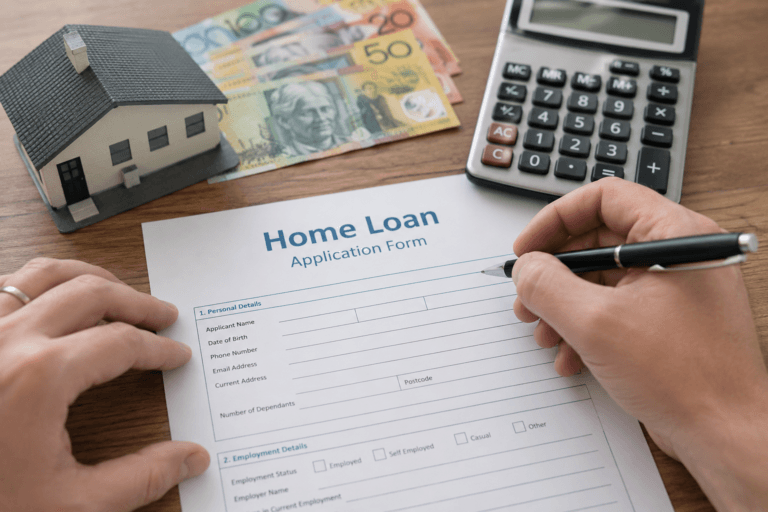

What every Australian graduate needs to know before applying for a mortgage – does HECS debt reduce your borrowing capacity, and by how much.
You studied hard, graduated, built a career, and now you’re ready to buy a home. But there’s a figure sitting quietly on your MyGov account that your lender is paying very close attention to – your HECS-HELP debt.
For millions of Australians, a university education came with a deferred price tag. And while HECS (Higher Education Contribution Scheme, now formally called HELP) is often described as “good debt” – interest-free, repaid through the tax system – the reality is that it can meaningfully reduce how much a bank will lend you. Sometimes by tens of thousands of dollars.
Here’s what you need to understand.
How Lenders Treat HECS Debt
When a lender assesses your home loan application, they look at two things: your ability to repay (serviceability) and your assets versus liabilities (deposit and equity position). HECS affects the first one – serviceability.
Most lenders factor your compulsory HECS repayment into their serviceability calculations so having a HECS debt does reduce your borrowing capacity. This repayment isn’t optional – it’s automatically withheld by the ATO once your income exceeds the minimum repayment threshold (currently $67,000 for the 2025–26 financial year, and you can also see the updated threshholds on the ATO website). From the lender’s perspective, it functions exactly like any other debt repayment: it reduces the money available to service a mortgage.
The repayment rate scales with your income. For example:
- Earning $70,000? Roughly 0.6% of your income goes to HECS – around $450 per year, or about $37.50/month.
- Earning $100,000? Around 5% – approximately $4,950 per year, or $412.50/month.
- Earning $130,000? Around 7.3% – approximately $9,550 per year, or $796/month.
That $412.50 or $796 per month is money a lender sees as already spoken for. It gets deducted from your “free” income before they calculate what mortgage repayment you can comfortably afford. The result? A lower maximum loan amount.
The Real-World Impact on Borrowing Power
The effect on borrowing capacity is more significant than most people expect.
As a rough illustration (individual results vary by lender and assessment rate):
A borrower earning $100,000 with no HECS debt might be assessed as able to borrow around $522,000–$608,000. The same borrower with a $40,000 HECS debt may find their borrowing capacity reduced by $63,000–$77,000 – sometimes more, depending on the lender’s methodology and assessment interest rate.
For borrowers in Sydney or Melbourne, where even a modest home can exceed $800,000, that shortfall matters. It can mean the difference between affording the property you want and being priced out of your target suburb.
The larger your HECS balance and the higher your income, the more pronounced the impact – because higher income means higher compulsory repayments, which means more of your cash flow is committed before the bank does its maths.
Not All Lenders Are the Same: The HECS Exclusion Threshold
Here’s where it gets interesting – and where smart borrowers can gain an edge.
Some lenders have introduced policies where they exclude HECS debt from their serviceability calculations if the balance falls below a certain threshold. The thresholds vary by lender and are subject to change, but the principle is consistent: if your remaining HECS balance is relatively small, it’s treated as negligible and not counted against your borrowing capacity.
This makes intuitive sense. A borrower with $4,000 remaining on their HECS balance is months away from having it cleared entirely. Penalising their borrowing capacity as heavily as someone with $80,000 outstanding doesn’t reflect the real picture.
In practice, this policy can make a meaningful difference. If you’re close to paying off your HECS debt – or if you’re considering making a voluntary lump-sum payment to bring it below a lender’s threshold – it’s worth modelling the impact on your borrowing capacity before you apply.
This is not a one-size-fits-all situation. Lender policies differ, thresholds change, and what one lender excludes, another will still count in full. This is one of the strongest arguments for working with a mortgage broker who actively knows which lenders will treat your HECS balance most favourably.
Should You Pay Down HECS Before Applying?
This is one of the most common questions in this space, and the answer is: it depends, but often yes — if you can do so strategically.
A few considerations:
The case for paying it down:
- If your balance is close to a lender’s exclusion threshold, a voluntary payment could unlock meaningfully higher borrowing capacity.
- Paying down HECS frees up long-term cash flow, even after your home loan is secured.
- It improves your serviceability position across most lenders, not just those with exclusion policies.
The case for keeping your cash:
- HECS is indexed to CPI (inflation), not a true interest rate. In a high-inflation environment, it grows – but historically it’s been relatively benign compared to other debt.
- Cash in an offset account against a home loan at 6%+ may generate more effective return than wiping a HECS balance.
- If you need your savings for a deposit, depleting them to pay HECS may cost you more in Lender’s Mortgage Insurance (LMI) than the HECS would have cost in reduced borrowing power.
The right answer depends on your income, your remaining HECS balance, the size of your deposit, your target property price, and which lender you’re approaching. Run the numbers – ideally with a broker who can stress-test both scenarios.
Practical Steps for HECS-Affected Borrowers
1. Know your balance. Log into your MyGov account and find your exact HECS balance. This is what lenders will use in their calculations.
2. Check the threshold policies. Your mortgage broker should be across which lenders currently exclude HECS below a certain amount, and whether your balance qualifies. This is a niche but important detail that changes over time.
3. Model the impact before you apply. Ask your broker to run serviceability calculations both with and without your HECS included, across a range of lenders. The difference can be illuminating.
4. Consider voluntary repayments strategically. If you’re $5,000–$10,000 above a lender’s exclusion threshold, a voluntary HECS payment might be the highest-return financial move you make this year – if it unlocks a significantly higher borrowing capacity without compromising your deposit.
5. Think about timing. ATO repayments are processed through your annual tax return. If you’ve recently had a pay rise that pushes you into a higher repayment bracket, make sure your broker is using your current income – not last year’s – in their assessment.
The Bigger Picture
HECS is often called “good debt,” and in many respects it is. It enabled millions of Australians to access higher education without upfront financial barriers. But in the context of home lending, it behaves like any other liability – it competes with your mortgage for the same pool of income.
The good news is that the system isn’t uniform. Lenders compete for your business, and some are more accommodating of HECS than others. The borrower who understands how this works – and who gets advice tailored to their specific balance and income – is far better positioned than the one who walks into their bank branch and accepts whatever number they’re given.
If you’re a graduate planning to buy a home, don’t let your HECS debt be a surprise. Understand it, plan around it, and find the lender whose policy works in your favour.
This article is general in nature and does not constitute financial advice. Individual borrowing capacity varies based on income, expenses, deposit size, lender policy, and other factors. Speak with us for guidance specific to your situation.
Need some help?
Not sure where to start? That’s exactly what we’re here for. Drop us a message and we will get back to you within one business day with clear, honest advice tailored to your situation.