

If you’ve used a few different borrowing power calculators, you may have noticed something confusing: different banks can tell you that you can borrow very different amounts of money.
You might enter exactly the same income, expenses and debts into two lenders’ calculators, only to find that one says you can borrow $700,000 while another says $800,000.
So which one is right?
The answer is that there isn’t one universal borrowing capacity for a borrower. Each lender has its own policies for assessing income, expenses, existing debts and other commitments.
This is one of the reasons that the amount you can borrow can depend on which lender you apply to.
Borrowing Capacity Isn’t Just About Your Salary
It is tempting to think that your borrowing capacity is simply a multiple of your income.
For example, you might assume that earning $100,000 means you should be able to borrow a certain fixed amount.
In reality, lenders generally look at a range of factors, including:
- Your base salary
- Overtime and penalty rates
- Bonuses and commissions
- Allowances and other income
- Existing loans and their repayments
- Credit card limits
- HECS/HELP or other student debt
- Your living expenses
- The number of dependants you have
- The proposed loan amount and term
- The lender’s assessment interest rate
- The lender’s individual servicing policies
The important part is that lenders don’t necessarily treat each of these things in the same way.
The Same Income Can Produce Different Results
Consider a hypothetical couple where both applicants earn $80,000 a year.
One applicant also earns around $20,000 in overtime each year, while the other receives around $20,000 in bonuses.
On paper, the household has $200,000 of annual income.
However, a lender may not necessarily treat the full $20,000 of overtime and the full $20,000 of bonuses as income available for servicing a home loan.
Some lenders may accept a high proportion of regular overtime income. Others may use a lower percentage or require evidence that the overtime is consistent.
Bonuses can be treated differently again. A lender might consider a portion of a regular bonus, while another lender may apply a different policy or require a longer history.
The result can be a significant difference in borrowing capacity.
An Example Using Quickli
The following example shows how the borrowing capacity for the same hypothetical couple can vary between lenders.
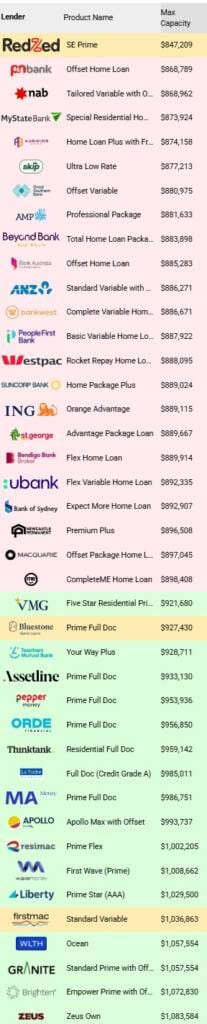
In this example, the applicants have the same financial circumstances as listed above, and I’ve assumed a $15,000 credit card and no other liabilities, but the estimated borrowing capacity changes depending on the lender being assessed.
Just based on this simplistic example, the borrowing power varies by over $200,000 across lenders. This isn’t because one bank has made a mistake.
It is because each lender is applying its own servicing methodology and income policies to the same information.
The figures in this example are illustrative only. Actual borrowing capacity will depend on the applicant’s circumstances and the lender’s policies at the time of application.
Why Do Lenders Treat Overtime Differently?
Overtime is a good example of why borrowing capacity can vary.
Someone might earn a base salary of $80,000 but regularly earn another $20,000 in overtime.
From the borrower’s perspective, that $20,000 may be a reliable part of their annual income.
However, a lender has to consider whether that income is likely to continue.
As a result, lenders can have different requirements around:
- How long you’ve been receiving overtime
- What industry you are in
- How consistent the overtime has been
- Whether it is guaranteed or discretionary
- What percentage of overtime income they will include
- Whether they require evidence from payslips or other documents
For some borrowers, the difference between a lender accepting most of their overtime and another lender accepting only part of it can have a substantial impact on borrowing capacity.
Bonuses Can Be Treated Differently Too
Bonuses present a similar issue.
Imagine two people who both earn $80,000 in base salary.
One receives a regular $20,000 annual bonus, while another receives an occasional bonus that varies significantly from year to year.
A lender may take a different view of these two situations.
The lender may look at the history of the bonus, how regularly it has been paid and whether there is evidence that it is likely to continue.
This means that $20,000 of bonus income isn’t necessarily worth the same amount for servicing purposes at every lender.
Your Existing Debts Matter as Well
Income is only one side of the borrowing-capacity calculation.
Lenders also look at your existing financial commitments.
For example, having a $10,000 credit card limit can affect your borrowing capacity even if you don’t currently owe anything on the card.
Similarly, existing personal loans, car loans, investment loans and other commitments can reduce the amount a lender is prepared to lend.
HECS/HELP debt can also affect borrowing capacity, with the impact depending on the lender’s assessment methodology and the borrower’s income.
This is another reason why two people with identical salaries can have different borrowing capacities.
Living Expenses Can Make a Difference
Lenders also need to assess how much you spend on living expenses.
That can include things such as:
- Groceries
- Utilities
- Insurance
- Transport
- Education
- Entertainment
- General household expenses
Lenders use different methods and assumptions when assessing living expenses.
Your actual declared expenses may be compared against a benchmark, and the lender will generally use the higher relevant figure when assessing your ability to repay the proposed loan.
So even if two lenders use the same income figures, differences in their expense assumptions can contribute to different borrowing capacities.
Why Your Bank’s Borrowing Calculator Isn’t Necessarily the Final Answer
Most banks have an online borrowing power calculator.
These can be useful for getting a rough indication, but they shouldn’t necessarily be treated as a definitive answer to the question “How much can I borrow?”
An online calculator may not capture every detail of your circumstances, and the result can change once a lender assesses your actual income and documentation.
More importantly, the calculator is generally designed around that particular lender’s lending policies.
So if Bank A’s calculator says you can borrow $750,000, that doesn’t necessarily mean $750,000 is your maximum borrowing capacity across the entire market.
Another lender may calculate a different result.
This Is Where Comparing Lenders Can Matter
For straightforward borrowers with a simple salary and no other debts, the difference between lenders may be relatively small.
For borrowers with more complicated income, the difference can potentially be much more significant.
This can include people who receive:
- Overtime
- Bonuses
- Commissions
- Casual income
- Allowances
- Self-employed income
- Multiple sources of income
In these situations, understanding how different lenders treat each type of income can be just as important as comparing interest rates.
A lender offering a slightly lower interest rate isn’t necessarily useful if its servicing policy means you can’t borrow enough to purchase the property you want.
Conversely, being able to borrow more doesn’t automatically mean you should borrow more.
The appropriate loan amount still needs to fit within your overall budget and circumstances.
So Which Bank Has the Highest Borrowing Capacity?
There isn’t one lender that always has the highest borrowing capacity.
It depends on who is borrowing and their particular circumstances.
A lender that produces the highest borrowing capacity for one borrower may produce a lower result for another borrower.
For example, one lender might have a particularly favourable approach to overtime income, while another might be more favourable for a borrower with commission income or a particular type of self-employed income.
Lending policies also change over time, so the lender that produces the highest result today isn’t necessarily going to produce the highest result in the future.
How a Mortgage Broker Can Help
A mortgage broker can compare your circumstances against the servicing policies of multiple lenders rather than simply relying on the borrowing calculator from your existing bank.
This can be particularly useful when your income isn’t entirely straightforward.
Rather than asking only:
“What is the lowest interest rate?”
it can be worth asking:
“Which lenders will assess my income and circumstances in a way that works for me?”
The answer can affect both your borrowing capacity and the range of properties you can consider.
The Bottom Line
If you’ve received different borrowing-capacity figures from different banks, that doesn’t necessarily mean one of them is wrong.
Each lender has its own approach to assessing:
- Income
- Overtime
- Bonuses
- Existing debts
- Living expenses
- HECS/HELP
- Dependants
- Interest rates and loan repayments
That’s why the same borrower can receive different borrowing-capacity results from different lenders.
If you’re trying to work out how much you can actually borrow, it’s worth looking beyond a single bank’s calculator and considering how multiple lenders assess your particular circumstances.
Want to see what your borrowing capacity could look like across different lenders?
Use our borrowing power calculator or get in touch with Ingram Financial to discuss your circumstances.
Borrowing capacity examples are indicative only. Actual borrowing capacity and loan approval are subject to lender assessment, lending criteria and the applicant’s individual circumstances.
The information in this article is general in nature and does not take into account your objectives, financial situation or needs. Lending criteria, fees and charges apply. Consider whether it is appropriate for you and speak to us for advice specific to your situation.