
Use this budget planner to help understand your income and expenses, and where you could make savings.
Where Could You Make Savings?
Use this budget planner to understand your spending habits and see how much you can save.
It also helps you identify any lifestyle changes you may need to reach your savings goal.
It provides an estimate. Call me and we can talk through your situation. I can then guide you on the next steps to achieve your goals.
How to use it: click Launch Calculator below, enter your details to see your estimate, then change the figures to compare different scenarios.

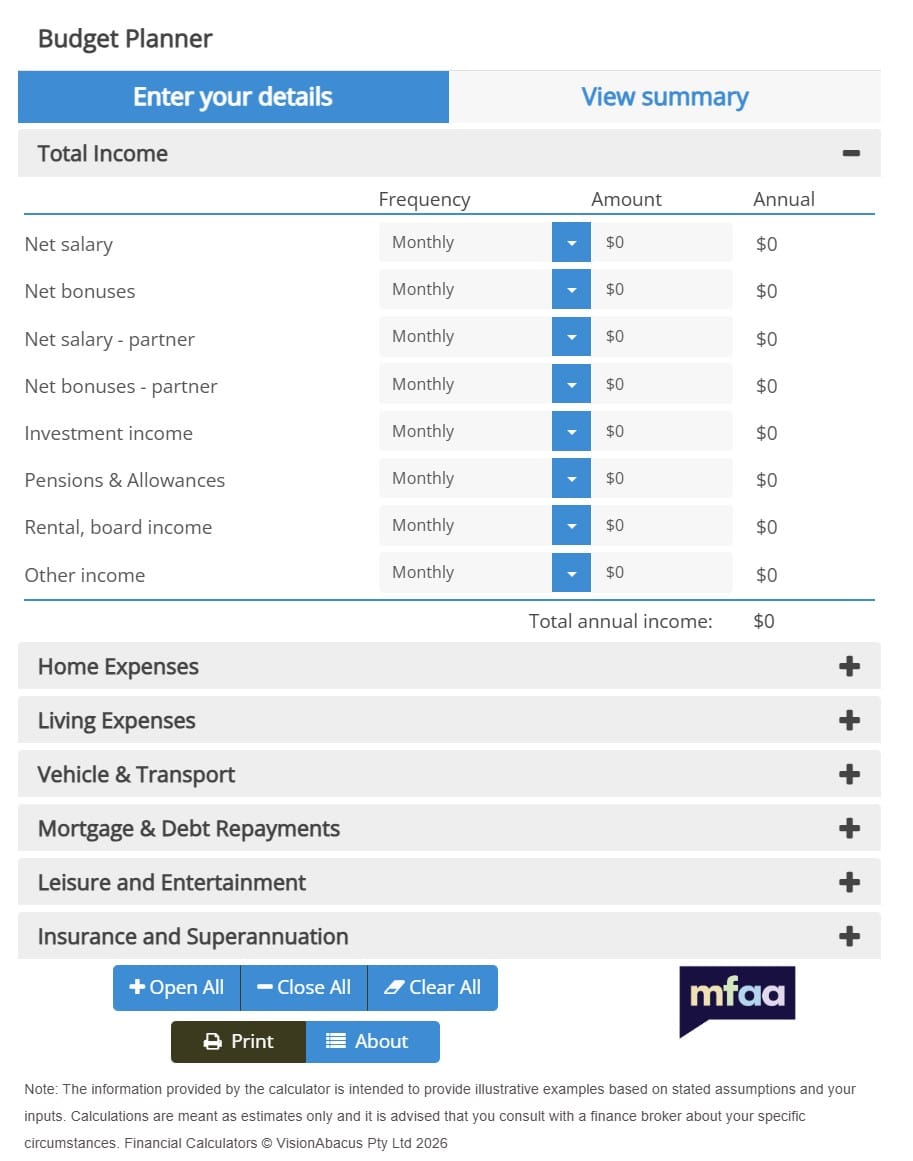
Budget Planner Calculator
Help plan your budget by looking at your income and expenses across a number of categories.
How to Use the Budget Planner
The budget planner above adds up what comes in and what goes out, so you can see your surplus or shortfall each month. It’s a simple tool, yet it answers a question every lender will ask: how much do you really spend?
- Start with income after tax, such as wages, regular government payments and investment income. If your income varies, use an average.
- Enter regular bills: rent or mortgage, groceries, utilities, insurance, transport, phone and internet.
- Add debt repayments, including credit cards, personal loans and car loans.
- Include irregular costs like car servicing, school fees, gifts and holidays, converted to a monthly amount.
- Finally, check your bank statements for anything you missed.
Moneysmart recommends a similar step-by-step approach in its guide on how to do a budget.
How to Read Your Budget Planner Result
If the budget planner shows money left over, that surplus is what you can save or put towards a home loan. On the other hand, a shortfall means you are spending more than you earn, so it’s worth finding savings before you take on a mortgage. Look at the biggest categories first, because a small cut to a large cost usually matters more than giving up small treats.
How Lenders Look at Your Living Expenses
When you apply for a home loan, you declare your living expenses and the lender checks them against your bank statements. Many lenders also compare your figure with a benchmark of typical household spending, such as the Household Expenditure Measure (HEM), which allows for things like household size and income. In general, the lender uses whichever figure is higher.
This matters because living expenses directly reduce borrowing power. As a result, a realistic budget before you apply helps you avoid surprises. You can test the effect with our borrowing power calculator.
Worked Example: Declared Expenses vs a Benchmark
The figures below are hypothetical round numbers, for illustration only, not a current rate or benchmark.
Imagine a couple with take-home pay of $9,000 a month who list their living expenses at $3,500 a month. Meanwhile, the benchmark a lender uses for a household like theirs comes to, say, $4,200 a month. In that case the lender would generally use $4,200, because it’s the higher figure.
After a car loan repayment of $600 a month, the lender sees $4,200 of spare income rather than the $4,900 their own budget shows. That $700 a month difference flows through to a lower borrowing power, so it helps to know about it before you start looking at properties.
Limitations of a Budget Planner
A budget planner only knows what you enter. It can’t see your real spending, and it doesn’t apply a lender’s benchmark or assessment rate. It also treats every month the same, whereas real life includes one-off bills. So review your budget every few months, and Moneysmart’s tips to track your spending can help you keep it accurate.
Next Steps: Saving for Your Deposit
Once you know your surplus, our savings planner calculator shows how long it could take to reach a savings goal. Our deposit guide explains how much deposit you may need, and genuine savings explained covers how lenders view your saving history. For loan options, visit our Home Loans page or first home loans page.
Local Help, Australia-Wide
Ingram Financial is a Sutherland Shire mortgage broker based in Bangor, NSW, and we also help clients across Australia by phone and video. If your budget feels tight, Shannon can talk through what lenders are likely to accept and how to get ready.
Budget Planner FAQs
Include all income after tax, regular bills, debt repayments and irregular costs such as car servicing, gifts and holidays. Your bank statements are the best place to check you haven’t missed anything.
HEM stands for Household Expenditure Measure. It’s a benchmark of typical household spending that many lenders compare with your declared expenses. Generally, the higher figure is used.
Yes. Most lenders review recent statements to confirm your income, spending and debts, so your declared expenses should match what the statements show.
Review subscriptions, insurance and utility plans, cut back on discretionary spending and reduce credit card limits. Keeping spending steady for a few months before you apply also helps.
Talk Through Your Budget
A budget planner is a great first step. Next, we can show you how lenders are likely to view your budget. Call Shannon on 0402 283 480 or book a time that suits you. You’ll receive our Credit Guide, which explains how we’re paid, before we start working together.
The information on this page is general in nature and does not take into account your objectives, financial situation or needs. Lending criteria, fees and charges apply. Consider whether it is appropriate for you and speak to us for advice specific to your situation.
Need Some Help?
Not sure where to start? That’s exactly what we’re here for. Drop us a message and we will get back to you within one business day with clear, honest advice tailored to your situation.