
You could potentially save thousands of dollars and take years off your loan by making extra repayments. Use our extra mortgage repayments calculator to run the numbers.
How Much Could You Save by Making Extra Repayments?
This extra mortgage repayments calculator helps you estimate these savings based on different repayment amounts over various terms. For more guidance, give us a call.
Looking for our standard mortgage repayments calculator? It’s over here.
How to use it: click Launch Calculator below, enter your details to see your estimate, then change the figures to compare different scenarios.

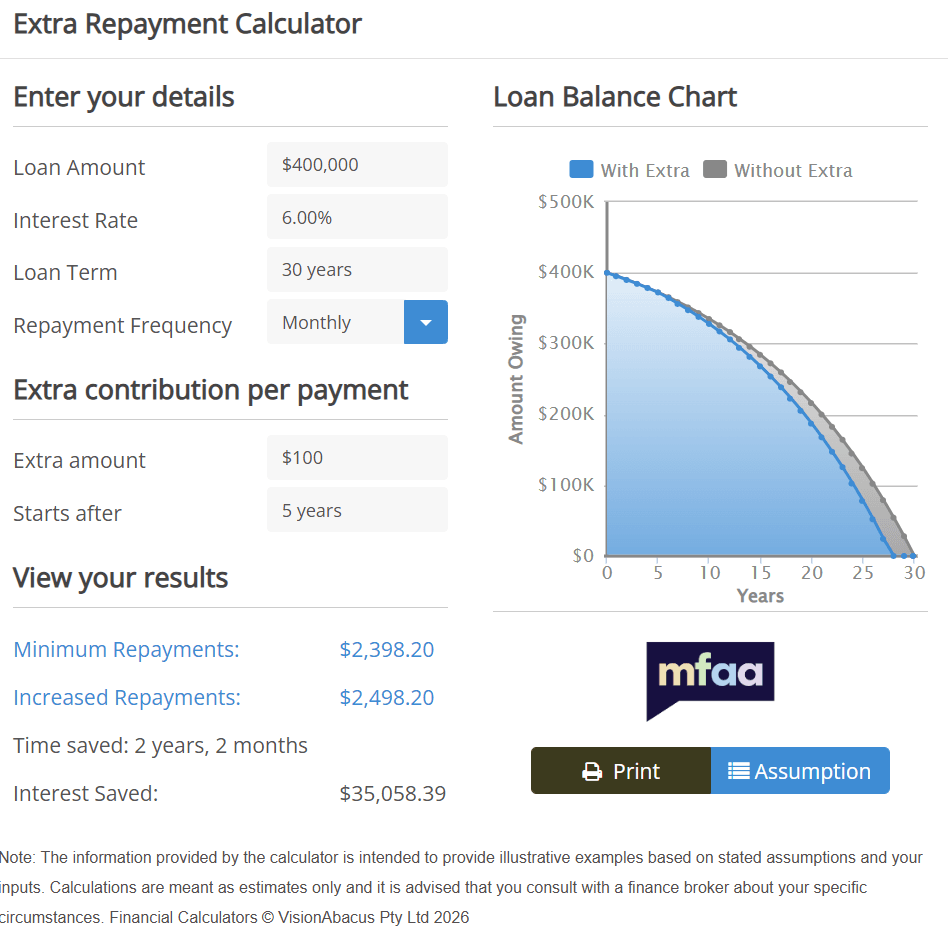
Extra Repayment Calculator
See the impact that making extra repayments can have on the duration of your home loan.
How Extra Repayments Work
Most home loans charge interest daily on the balance you owe. So when you pay more than the minimum, the extra goes straight off the principal, and every future interest calculation starts from a lower balance. Over time, more of each regular repayment goes to principal instead of interest, and the loan finishes sooner.
Extra repayments usually do the most good early in the loan, when the balance and the interest charges are highest. Even small, regular amounts can add up, as the example below shows.
A Worked Example Using the Extra Mortgage Repayments Calculator
For illustration only, imagine a $500,000 loan over 30 years at a hypothetical rate of 6.5% a year, with monthly principal and interest repayments. This rate was chosen for round numbers and is not a current rate. The minimum repayment would be about $3,160 a month, and total interest over 30 years would be roughly $638,000.
- Paying an extra $200 a month could clear the loan almost five years sooner and save roughly $118,000 in interest.
- Paying an extra $500 a month could clear it about nine years sooner and save roughly $225,000 in interest.
These figures are rounded and assume the rate never changes, which is unlikely in practice. Therefore, enter your own loan details in the extra mortgage repayments calculator above for a personalised estimate.
Things to Check Before You Pay Extra
- Fixed-rate limits: many fixed loans cap extra repayments during the fixed term, and paying more than the cap can trigger fees. Check your loan terms first.
- Redraw access: extra repayments usually sit in redraw. Some lenders charge redraw fees, set minimum amounts or can limit access, so keep an emergency buffer elsewhere.
- Redraw or offset: an offset account can save similar interest while keeping your money in a separate account. Read our offset vs redraw guide to compare.
- Investment loans: paying down an investment loan and then redrawing can affect how much interest is tax deductible, so speak to your accountant first.
Other Ways to Pay Off Your Mortgage Sooner
Extra repayments are only one option. For example, Moneysmart notes that switching from monthly to fortnightly repayments of half the monthly amount works out to about one extra monthly repayment each year. You can also compare how savings in an offset account would work using our mortgage offset calculator, or model a one-off amount with the lump sum repayment calculator.
Finally, a lower rate helps every repayment go further. After several rate rises in 2026, many borrowers are reviewing their loans. If you haven’t checked yours recently, our refinancing page explains how we compare lenders for you.
Extra Repayments FAQs
Both reduce the interest you pay in a similar way. An offset keeps your money in a separate account you can use, while extra repayments usually go into redraw, where access can be more limited. The best choice depends on your loan, your habits and, for investors, tax.
Often only up to a limit set by the lender during the fixed term. Paying more than the limit may cost you fees, so check your loan terms or ask us.
Usually not. Most lenders keep your scheduled repayment the same and the loan simply finishes earlier. Some lenders can recalculate the repayment on request.
It gives an estimate based on the figures you enter and assumes the rate stays the same. Real results depend on rate changes, fees and your lender’s terms.
The information on this page is general in nature and does not take into account your objectives, financial situation or needs. Lending criteria, fees and charges apply. Consider whether it is appropriate for you and speak to us for advice specific to your situation. Speak to your accountant or tax adviser about tax.
Need Some Help?
Not sure where to start? That’s exactly what we’re here for. Drop us a message and we will get back to you within one business day with clear, honest advice tailored to your situation.