
Invest in new equipment or upgrade your business assets to grow your business. Asset finance lets you spread the cost of a ute, van, truck or tools over a set term, so you keep cash in the business. I help tradies and small businesses in the Sutherland Shire, as well as clients across Australia by phone and video.

What Is Asset Finance?
Asset finance is a loan or lease used to buy something your business needs to earn income. Usually, the asset itself secures the loan, so lenders treat it differently from an unsecured business loan.
It mainly suits self-employed clients, small business owners and contractors. In saying that, it’s still possible to get personal asset finance, and one of the most popular options is buying a car. For personal vehicles, though, our car loans page explains more.
Compared to paying cash, the benefits can include freeing up capital, improving cash flow and reducing upfront costs.
What Can You Finance?
- Utes, work vehicles and vans
- Trucks and trailers
- Tools and trade equipment
- Machinery such as excavators and forklifts
- Medical and office equipment
- IT hardware and point-of-sale systems
Generally, lenders prefer assets that hold their value and resell easily. In contrast, specialised or older equipment can be harder to finance.
The Asset Finance Process
It’s simple. We’ll look for the asset finance solution that works in your best interest.
Get in touch to discuss your current financial situation and goals, in person or online.
We’ll research our panel of banks and lenders to create a shortlist of asset finance solutions that suit you.
Once you’ve chosen a lender, we’ll apply for pre-approval.
Time for you to decide on the equipment you need to run or expand your business.
We’ll complete all of the paperwork to secure finance from your lender.
Once the agreement is final, you buy the asset and start using it, without a large lump sum outlay.
Understanding Common Asset Finance Options
Chattel Mortgage
Commonly used by business owners for car and equipment finance. With a chattel mortgage, you own the asset from the outset and the asset secures the loan. In effect, it works like a secured business loan.
Commercial Hire Purchase
You get the equipment or car you need and pay hire charges over a fixed period. Once you make the final payment, you own the asset.
Finance Lease
Finance leases suit businesses wanting the option to buy at the end of the lease or hand back the asset. Meanwhile, the lender owns it and you pay to use it.
Novated Lease
A novated lease lets an employee lease a car through their employer. The financier owns the car, while you and your employer sign a novation agreement to share the responsibilities. If a novated lease suits you, I’ll generally refer you to a specialist provider.
GST and Tax: Ask Your Accountant
However, GST and tax treatment differ between these structures. The ATO explains when businesses can claim GST credits, and its instant asset write-off page sets out the current rules for small businesses. Interest, lease payments or depreciation may be deductible, depending on the structure.
Because the right answer depends on your business, it’s a good idea to talk to your accountant whenever you’re planning a big financial decision for the business.
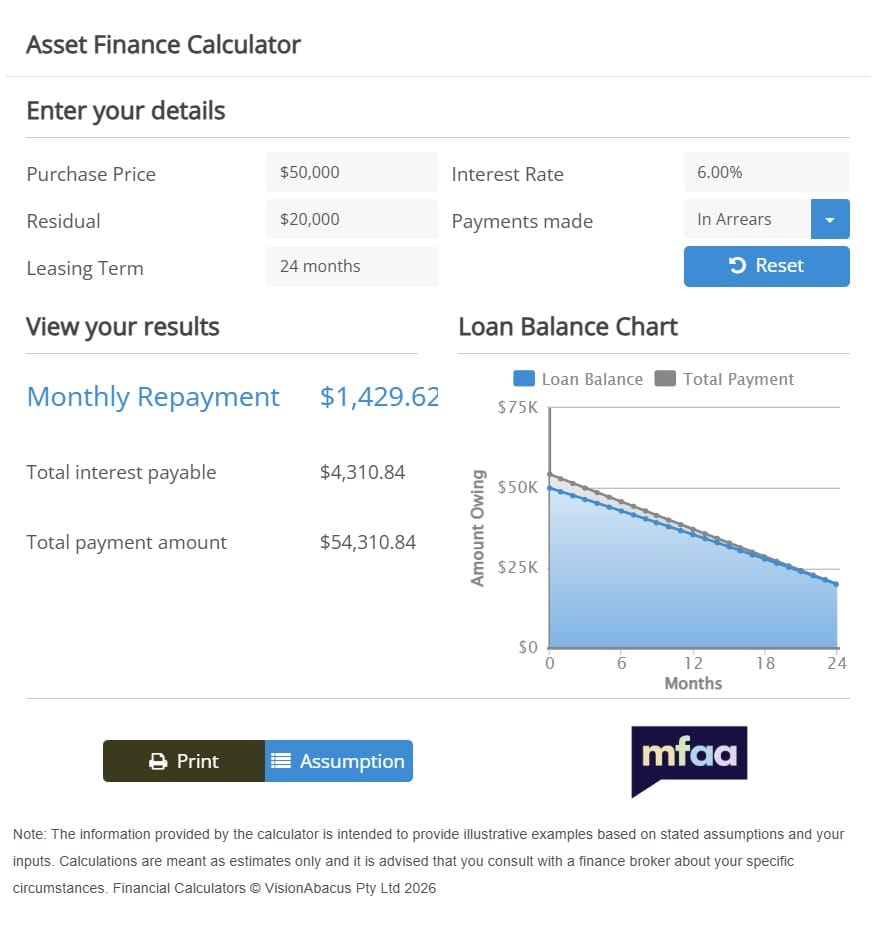
Balloon Repayment Calculator
Easily see your repayments based on a specified loan amount, interest rate and term and the impact that a residual or balloon payment can have on them
Other Things to Consider: Balloon Payments
You choose to pay a larger sum of the loan value at the end of the loan term. Usually, the lender works it out as a percentage of the total loan value.
Reduce your repayments when you first start paying off the loan.
However, consider how this affects the interest you pay over the life of the loan. You must also pay the remaining sum in one lump sum at the end.
We can help you understand whether this approach suits your needs. Get in touch.
So, plan how you will pay the balloon, whether from savings, a trade-in or refinancing. Before you decide, try our balloon payment calculator to see the difference it makes.
What Lenders Look at for Asset Finance
- ABN age: many lenders prefer a couple of years, while some consider newer businesses.
- GST registration: this can widen your lender choice.
- Financials or low doc: larger loans usually need tax returns, but some lenders offer low doc options for smaller amounts.
- The asset: its age, type and resale value.
- Deposit or trade-in: either one reduces the loan and strengthens the application.
How Asset Finance Affects Your Home Loan
A new ute or equipment loan adds a monthly repayment, and lenders include it when they work out your home loan borrowing capacity, even when the business pays it. Some lenders look past a business vehicle loan, while others count it in full. Therefore, if you plan to buy a home and upgrade your ute in the same year, talk to me first. Also, our self-employed home loans guide explains more.
Asset Finance for Sutherland Shire Trades
From the industrial estates of Taren Point and Caringbah to the workshops around Kirrawee, many Shire businesses rely on a ute, a van or a trailer full of tools every day. As a Sutherland Shire mortgage broker based in Bangor, I know how local trade businesses run. For premises, stock or working capital, see our business loans page.
How I Help With Asset Finance
Because I ran my own multi-site retail business from 2016 to 2024, I understand cash flow and equipment costs. First, I look at what you are buying and any home loan plans. Then I work out which lenders and structures suit you. Once I have your documents, I can usually submit within a day, although lender turnaround varies.
Depending on the amount and your situation, I may refer you to a lender or another broker who specialises in that finance, and they may charge a fee. Either way, you’ll see any fees, and I’ll explain them, before you sign anything.
Asset Finance FAQs
Structures and Eligibility
With a chattel mortgage, you own the asset from the start and the lender holds security over it. In contrast, with a finance lease, the lender owns the asset and you pay to use it.
Possibly. Many lenders prefer a couple of years of ABN history, but some will consider newer businesses, especially with a deposit, a trade-in or past experience in the same industry.
Not always. For smaller amounts, some lenders offer low doc options. However, larger loans usually need tax returns or financial statements.
Home Loans and Tax
Usually, yes. Lenders count the repayment when they assess a home loan, even if the business pays it. So, talk to a broker about the order first.
It can be, depending on the structure and how you use the asset. Speak to your accountant or tax adviser before you choose a structure.
Talk to a Local Broker About Asset Finance
Whether you need a ute, a van or new equipment, a quick chat is the easiest place to start. Together, we’ll work out the best way to fund it.
The information on this page is general in nature and does not take into account your objectives, financial situation or needs. Lending criteria, fees and charges apply. Consider whether it is appropriate for you and speak to us for advice specific to your situation. Speak to your accountant or tax adviser about tax.
Need Some Help?
Not sure where to start? That’s exactly what we’re here for. Drop us a message and we will get back to you within one business day with clear, honest advice tailored to your situation.